

St. Johns County Shore Protection Project at St. Augustine Beach
Announcements
The City of St. Augustine Beach has officially signed the Perpetual Beach Storm Damage Reduction Easement for the St. Augustine Shore Protection Project!
We are pleased to share this exciting news with the community!
The signing of this easement is a significant milestone for the project area and a major step forward in achieving 100% participation in perpetual easements.
Since the project was initiated in the early-2000s, we have had 5 nourishment events, totaling about 12 million cubic yards of sand placed! The execution of this easement demonstrates the City’s strong support for the project and its commitment to protecting the community, as well as the homes, businesses, natural environment, and infrastructure along St. Augustine Beach.
In addition, we have now received signed perpetual easements from more than 50% of the required property owners. While this represents significant progress, we must obtain signed easements from 100% of property owners within the project area. Without full participation, the U.S. Army Corps of Engineers will not return to construct and complete future projects, which would have a significant impact on the community.
We appreciate the continued support and efforts of the community in maintaining the partnership between St. Johns County and the U.S. Army Corps of Engineers, allowing the St. Augustine Shore Protection Project to continue protecting the beach for years to come.
YouTube video: St. Augustine Beach Shore Protection Project Easements – Update
Overview
Project Details
The project consists of a 50-year federal commitment to design, construct and monitor beach restoration of the severely eroded beaches of Anastasia State Park and St. Augustine Beach. A federal project is authorized for the FDEP-designated critical erosion area between 4,000’ north of Pope Road in Anastasia State Park to Ocean Hammock Park. The USACE does not place sand on the whole authorized area each nourishment event.
The project is currently on pause due to a new USACE requirement for 100% perpetual easements and waivers for property owners within the project area.
If you are a property owner interested in signing an easement, please contact us:
Coastal Projects
- Phone: 904-209-0260
- Email: coastalprojects@sjcfl.us
Header text
Previous Meetings
November 3, 2025 – City of St. Augustine Beach Commission Meeting: At the November 3rd, 2025 City of St. Augustine Beach Commission Meeting, St. Johns County Staff brought back the request for COSAB to execute easement for the properties it owns. The Commission voted to approve the signing of the perpetual easements, in support of the continued project partnership with USACE.
September 4, 2025 – City of St. Augustine Beach Commission Meeting: At the September 4th, 2025 City of St. Augustine Beach Commission Meeting, St. Johns County Staff presented on the need for perpetual easements for this project. County staff presented the easement matter to the Beach Commission, which included the request for the City to execute easements for the properties it owns. The COSAB Commission requested additional time to review the request prior to making a decision.
If you are a beachfront property owner within the project area that has not yet signed an easement and waiver, copies were available to sign & notarize at the meeting. Those not signed have been mailed to the property owner.
May 14, 2025 – Community Meeting: A community meeting was held on May 14th, 2025 to discuss the importance of these perpetual easements and answer any questions from residents within the project area. A copy of the presentation and a video recording of the meeting are linked below.
History
Initial construction of the USACE’s St. Johns County Shore Protection Project (SPP) was completed in January 2003. The project placed about 3.8 million cubic yards (MCY) of sand in the project area.
The first renourishment, in 2005, placed about 2.8 MCY of sand. This was 100% federally funded through Flood Control and Coastal Emergencies (FCCE) appropriation.
The second renourishment was completed in 2012 and placed about and 2.1 MCY of sand.
The third renourishment was completed in June 2018. This event placed about 750,000 MCY of sand, dredged from the St. Augustine Inlet ebb shoal.
The fourth renourishment completed in September 2024, which placed approximately 2.5 MCY of sand. This event was federally funded through the USACE’s emergency storm repair program in 2023, similar to the 2005 renourishment.
For more information, please see the Army Corps website.
Funding
The project has been fully approved and funded using a combination of USACE, State, County Tourist Development “Bed Tax” funds.
The 2024 renourishment event was 100% federally funded through FCCE.
The Beach Brief – An E-newsletter for Timely Updates on St. Johns County Beach Projects
St. Johns County remains dedicated to providing our residents, visitors, and businesses with timely and accurate information regarding current and upcoming St. Johns County beach projects. The monthly “Beach Brief” provides subscribers with an overview of beach renourishment, dune enhancement, and other major coastal projects.
FAQs
1. Why is there sand under the pier?
Coastal reaches, segments of the ocean shoreline, are not all equal. Because of natural variations in beach topography and the impact of man-made structures such as seawalls and armoring, some locations along any coastline are more vulnerable to erosion, while others are more likely to accrete sand that migrates in the coastal sand budget.
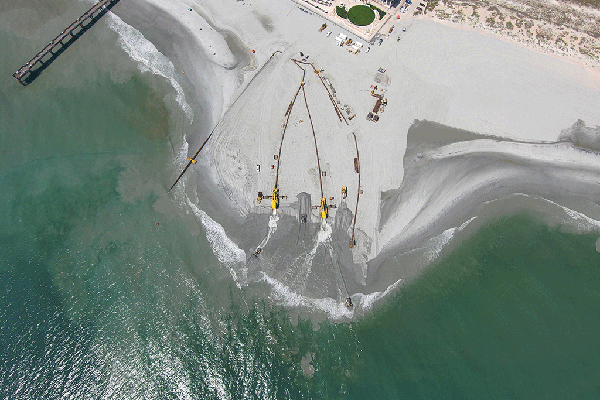
That particular location, St Augustine Beach Pier and the Embassy hotel immediately to its north, is the most highly erosive within the footprint of the federal shore protection project and one of the most highly erosive in St Johns Co. The present beach renourishment project is designed to include significantly greater amounts of sand in this area to compensate for that high erosion rate.
While the ongoing sand placement has temporarily left the pier “high and dry,” waves and currents will in the weeks and months ahead reshape the constructed beach fill by spreading sand to the adjacent parts of the coast through a process known as equilibration. Sand will be transported from the dry beach and deposited below the waterline within the active beach profile, which will help dissipate wave energy naturally generated by storms, for instance, thereby providing the intended coastal storm risk management benefits.
The sand placement is designed to do exactly this, to spread the defensive resistance to wave and storm energy throughout the beach profile, thereby strengthening the entire local coastline. This process begins immediately after construction, with a full adjustment of the beach shape typically requiring months or multiple significant wave events to be complete. See the attached graphic, which illustrates the process.
The pace of the re-shaping is in large part dependent of wave and storm activity. The greater the coastal storm activity, the shorter the duration of the equilibration process. In time, the St Augustine Beach Pier will reach out into the ocean, we just cannot predict when.
2. Will I be able to access the beach during the project?
For safety purposes, there will be no beach access in areas of active construction. These areas are blocked off by red-orange construction fencing as the construction area moves down the beach.
Once a beach fill area is complete and the area is safe for public use, the Contractor will remove construction fencing and access to the beach may resume.
3. What are the anticipated hours?
Dredging and sand placement will occur 24 hours a day, 7 days a week.
4. Will it be loud near the active construction site?
Please expect there to be beeping noises and the movement of heavy machinery (bulldozers) within active construction areas.
5. What protections are being provided for wildlife during the project?
Trained environmental monitors conduct daily inspections to ensure the safety of sea turtles and shorebirds.
Sea turtle nests laid within the immediate project work zone will be relocated to safe areas locally.
The project is limited to progressing 500 feet during the night, which is fenced off before dark.
Project lighting is shielded to limit the direct lighting to the immediate area of active construction.
The dredges utilize specialized equipment to minimize the impact to endangered species within the borrow area.
The Contractor must abide by the environmental protection conditions listed in the State and Federal permits.