


SUN Trail in St. Johns County
Regional Project Overview
The SUN (Shared-Use Nonmotorized) Trail in St. Johns County is part of a larger, coordinated regional effort to develop a continuous, multi-use trail network across Northeast Florida. This regional loop trail is anticipated to be the longest of its kind in the southeastern United States, totaling approximately 260 miles upon completion.
Within this system, nearly 40 miles of trail are planned in St. Johns County, including segments within the City of St. Augustine and the City of St. Augustine Beach. This places the County as a key connection point within the broader regional network.
The trail system connects to major statewide and national networks, including the East Coast Greenway and the Coast to Coast Trail, supporting both regional and long-distance connectivity for walking, biking, and other nonmotorized uses.
SJC Project Overview
The SUN Trail network in St. Johns County has been developed through a long-term, multi-agency planning process involving local governments, regional partners, and the Florida Department of Transportation.
Five Primary Segments
- Vermont Boulevard to CR 214
- Allen Nease Road to Prairie Lakes Drive (including a planned pedestrian bridge crossing)
- Prairie Lakes Drive to Holmes Boulevard
- West King Street from Holmes Boulevard to US 1
- Pope Road to A1A (Beach Boulevard)
Current outreach and design discussions are focused on the Pope Road to A1A (Beach Boulevard) segment.
Regional Trail System
The regional loop trail spans five counties in Northeast Florida:
- St. Johns County
- Flagler County
- Volusia County
- Brevard County
- Putnam County
This effort has been carried out across multiple jurisdictions and transportation districts, reflecting a coordinated approach to building a connected trail system that supports mobility, recreation, and access across the region.
The project is part of Florida’s SUN Trail Program, which was established to fund the development of regionally significant, nonmotorized transportation corridors.
Planning Study
A comprehensive planning study was completed to evaluate potential trail alignments, design considerations, and community impacts within St. Johns County.
Study Focus
- Identifying feasible trail routes and design types
- Supporting coordination between St. Johns County, the City of St. Augustine, and the City of St. Augustine Beach
- Positioning the project to compete for state funding through the SUN Trail Program
- Incorporating public input through a structured public involvement process
A full planning study document will be made available on this page once it has been updated to meet ADA accessibility standards.
Community Engagement and Meetings
St. Johns County has hosted public meetings and open house events to share project information, answer questions, and gather community input throughout the planning and design process.
As the project continues to move forward, updates will be shared here to provide accurate, up-to-date information for residents, businesses, and stakeholders.
Past Public Meetings
- July 11, 2019 – Solomon Calhoun Center
- October 24, 2019 – Solomon Calhoun Center
- February 26, 2026 – Anastasia Island Public Library
Purpose and Benefits
SUN Trail Intention
- Expand safe, connected options for walking and biking
- Improve access between neighborhoods, parks, and local destinations
- Support regional connectivity across Northeast Florida
- Enhance recreational opportunities for residents and visitors
This project reflects a long-term investment in infrastructure that balances mobility, environmental stewardship, and community character.
Project Renderings
Click images for larger view
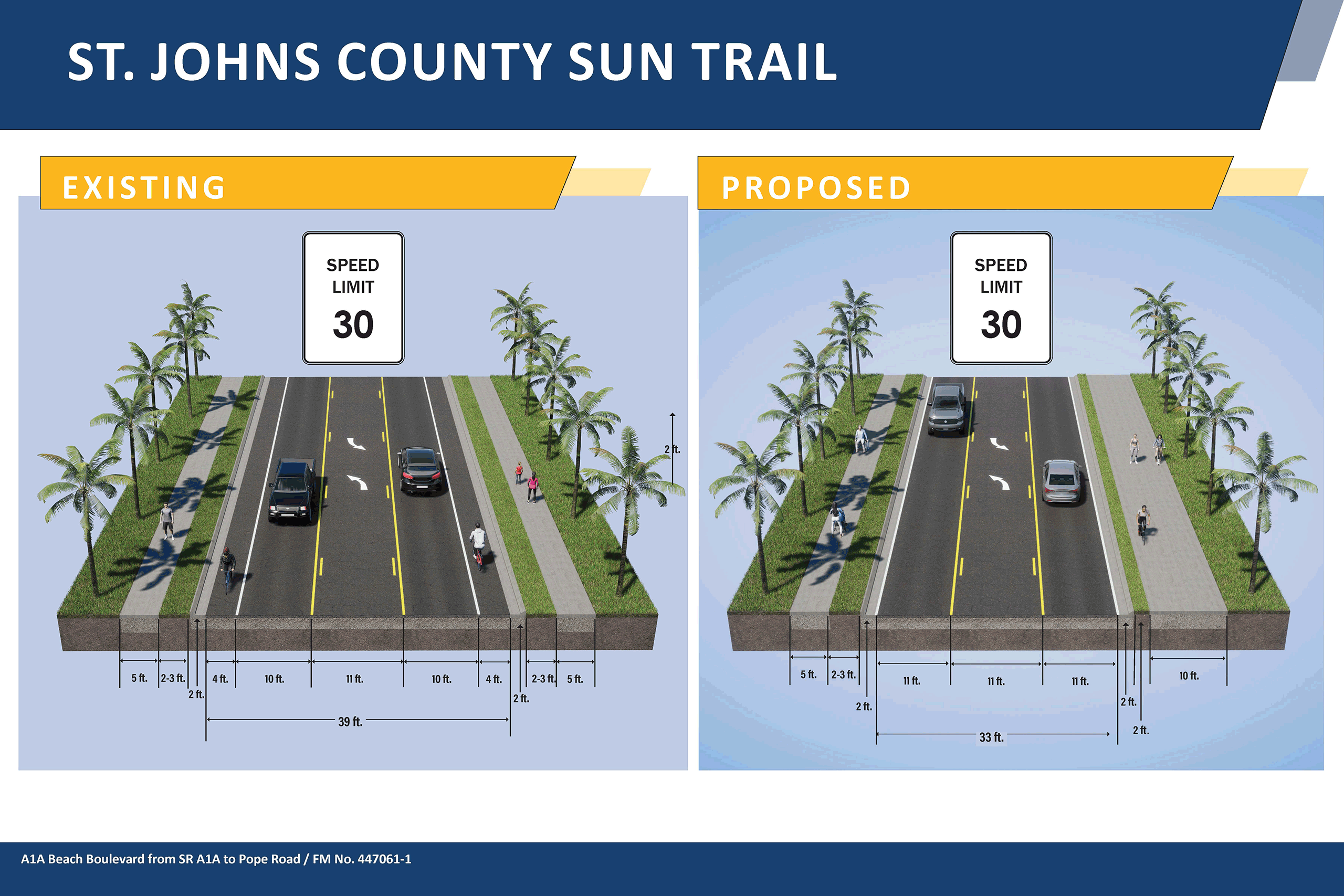
Image 1: Rendering showing a cross section of A1A Beach Boulevard from SR A1A to Pope Road. The existing configuration, shown on the left, includes two travel lanes, a center turn lane, bicycle lanes and sidewalks. The proposed SUN Trail configuration, shown on the right, removes the center turn lane and adds a wider shared-use path on the east side of the roadway.
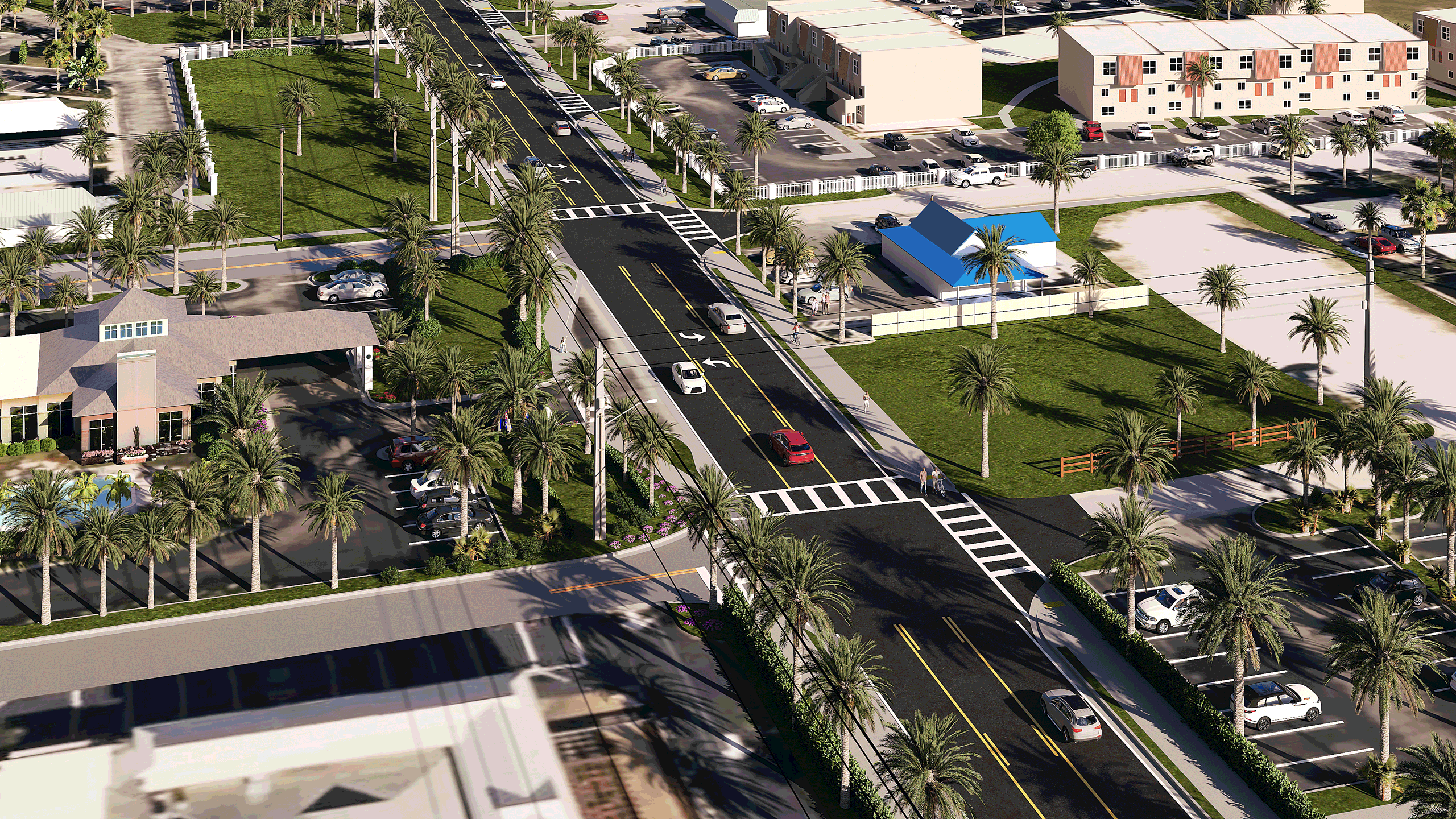
Image 2: Rendition looking northeast of the proposed 10-foot wide concrete SUN Trail at Beach Boulevard between Pope Road and A1A showing crosswalks and moving traffic.
Image 3: Rendition looking northeast at a slightly different angle than previous image of the proposed 10-foot wide concrete SUN Trail at Beach Boulevard between Pope Road and A1A showing crosswalks and moving traffic.
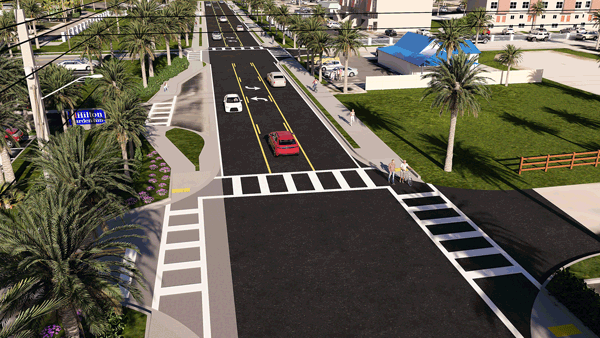
Image 4: Rendition with a closer view looking north of the proposed 10-foot wide concrete SUN Trail at Beach Boulevard between Pope Road and A1A showing crosswalks and moving traffic.

Image 5: Birds-eye-view rendition of the proposed 10-foot wide concrete SUN Trail at Beach Boulevard between Pope Road and A1A showing crosswalks and moving traffic.
SUN Trail Timeline
Segments of the SUN Trail within St. Johns County are in various stages of development, including planning, design, and future funding consideration.
All segments are currently in design and permitting.
RES 2008-200 August 5, 2008 (SJC BOCC)
Approves the terms, provisions, conditions, and requirements of a memorandum of understanding between St Johns County, Brevard County, Flagler County, Volusia County, and Putnam County, Florida, concerning certain aspects of the River to Sea Loop.
RES 2017-125 April 18, 2017 (SJC BOCC)
Authorizes the Agreement with the Florida Department of Transportation (FDOT) for a planning study of the SUN Trail. Accepts a $750,000 FDOT grant and appropriates the funds for use on the Planning Study.
RES 2018-15 June 16, 2018 (SJC BOCC)
Authorizes the award of RFQ No. 18-21 for the Florida SUN Trail Network Agreement with the Florida Department of Transportation (FDOT) for a planning study. Authorizes negotiations and execution of an agreement to complete the planning study.
RES 2019-11 Nov 4, 2019 (COSAB)
States the City of St Augustine Beach support of preferred alignment.
RES 2019-45 & 46 Nov 11, 2019 (COSA)
RES2019-45 States City’s Support of Preferred Alignment. RES2019-46 enters the City of St Augustine into a maintenance agreement for the trails.
RES 2019-389 Nov 19, 2019 (SJC BOCC)
Adopts the Preferred Alignment and Route for the SUN Trail in the Project Planning Study. Expresses the Board of County Commissioners’ formal support for the identified Preferred Alignment.
RES 2024-146 April 2, 2024 (SJC BOCC)
Approves the execution of the funding agreement for design of the segment on Beach Blvd from Pope Rd to SRA1A; the design, construction, and CEI of the sections on Allen Nease Rd from existing trail to CR 214; on CR 214 from Holmes Blvd to US 1; on CR 214 from Prairie Lake Dr to Holmes Blvd; on CR 214 from Allen Nease Rd to Prairie Lake Dr.